TRACE
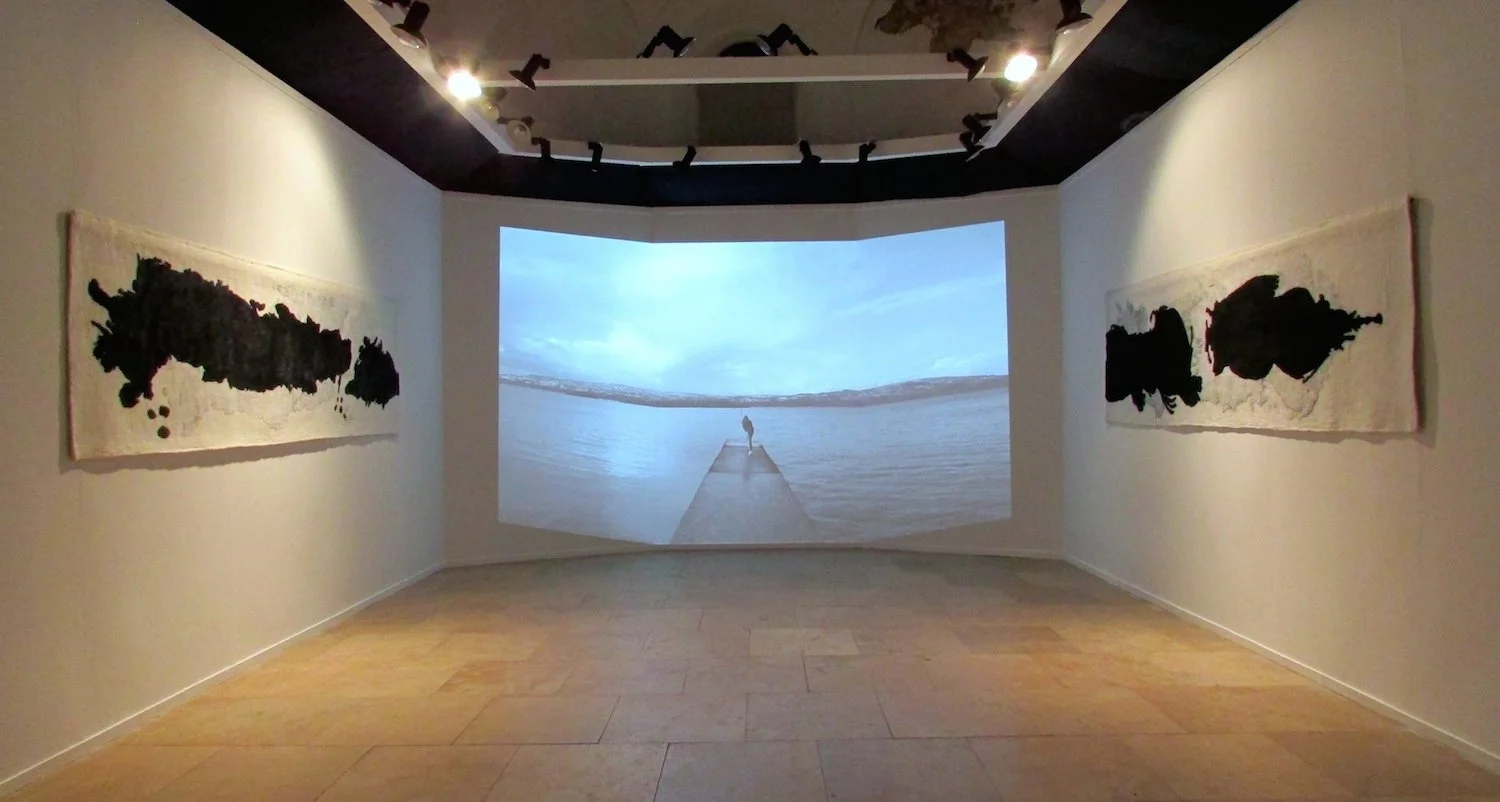
Site Specific Installation, Serbian Church Gallery, Balassagyarmat, Hungary
Curator Zsolnyanszki Zsolt Benedek,
Guest Speaker Tamas Torok curator, New Budapest Gallery
Date: February 6th - March 7th, 2015
TRACE explores mark-making through motion, the ways customary acts performed daily become embedded in our memory, and how these movements leave traces and patterns behind.
The work looks at domestic labor traditionally carried out by women: repetitive acts that are often considered menial or invisible, yet are deeply connected to care, memory, and the rhythms of everyday life. At the center of the work is the act of mopping; the dipping of the mop into the water and the slow, repeated movement across a surface. Through this motion, a mundane household task becomes a moment of stillness and mindfulness.
The work is rooted in the relationship between my grandmother and me, and in the generational difference between how we understood domestic labor. For my grandmother, mopping the floor was more than a household chore. It was an act of love and devotion to her family and children. Her dedication to the task was part of how she expressed care and created a home.Two generations later, I experienced the same repetitive act very differently. At the time, the daily ritual of mopping felt meaningless to me. It represented a form of traditional women's labor; expected, repetitive, and largely invisible. What my grandmother understood as an expression of love, I initially understood as an obligation.TRACE revisits this gesture through the distance of time and generations. The water and the movement of the mop become the starting point for the work. On opposing walls, soft merino wool felt traces the marks left behind by the mop, translating the movement of the body and the temporary path of water into a static form.
The felt preserves what would normally disappear. A fleeting domestic action becomes a permanent trace. The softness of the merino wool transforms the physical evidence of mopping into something tactile, quiet, and unexpectedly beautiful. The work elevates an ordinary and often overlooked gesture, allowing the labor to be seen, felt, and reconsidered. In this transformation, the mop is no longer simply a tool for cleaning. Its movement becomes a form of drawing; the water becomes a medium; and the trace becomes a record of labor, memory, love, and generational difference.
TRACE seeks to preserve a momentary action in time and space—a movement that might otherwise disappear, leaving behind only a trace.
Supported by the Art Council of Ireland Travel and Training Award, and ChaShaMa Art Residency Award
Exhibition Review by Debreceni Boglarka, at the HVG - MUERTO (in Hungarian) please click here.
Television Review (in Hungarian) please click here