Hunia - Permission to Be
Installation, Video performance

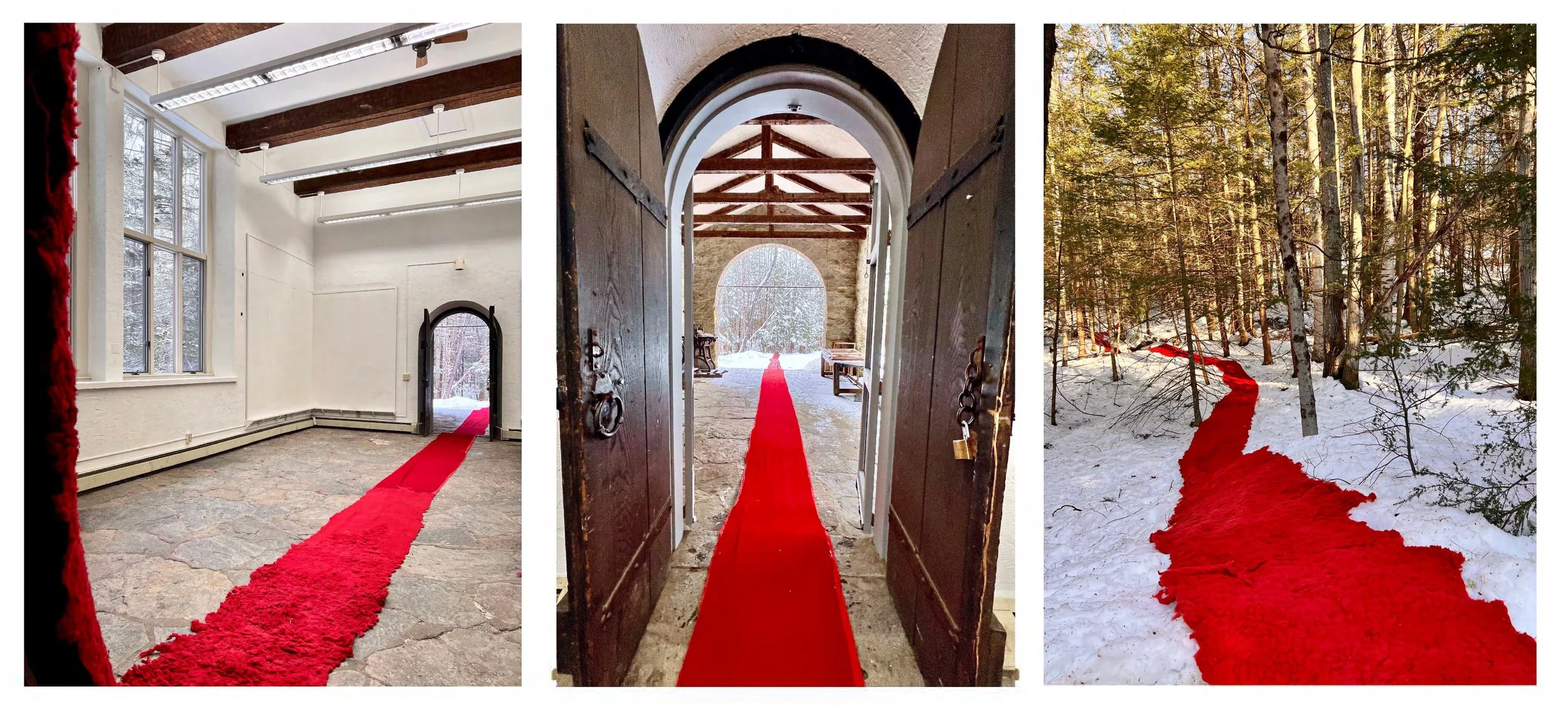
The project was developed, Hunia was made, and the performance segments were filmed in different outdoor locations on MacDowell's grounds in February 2023.
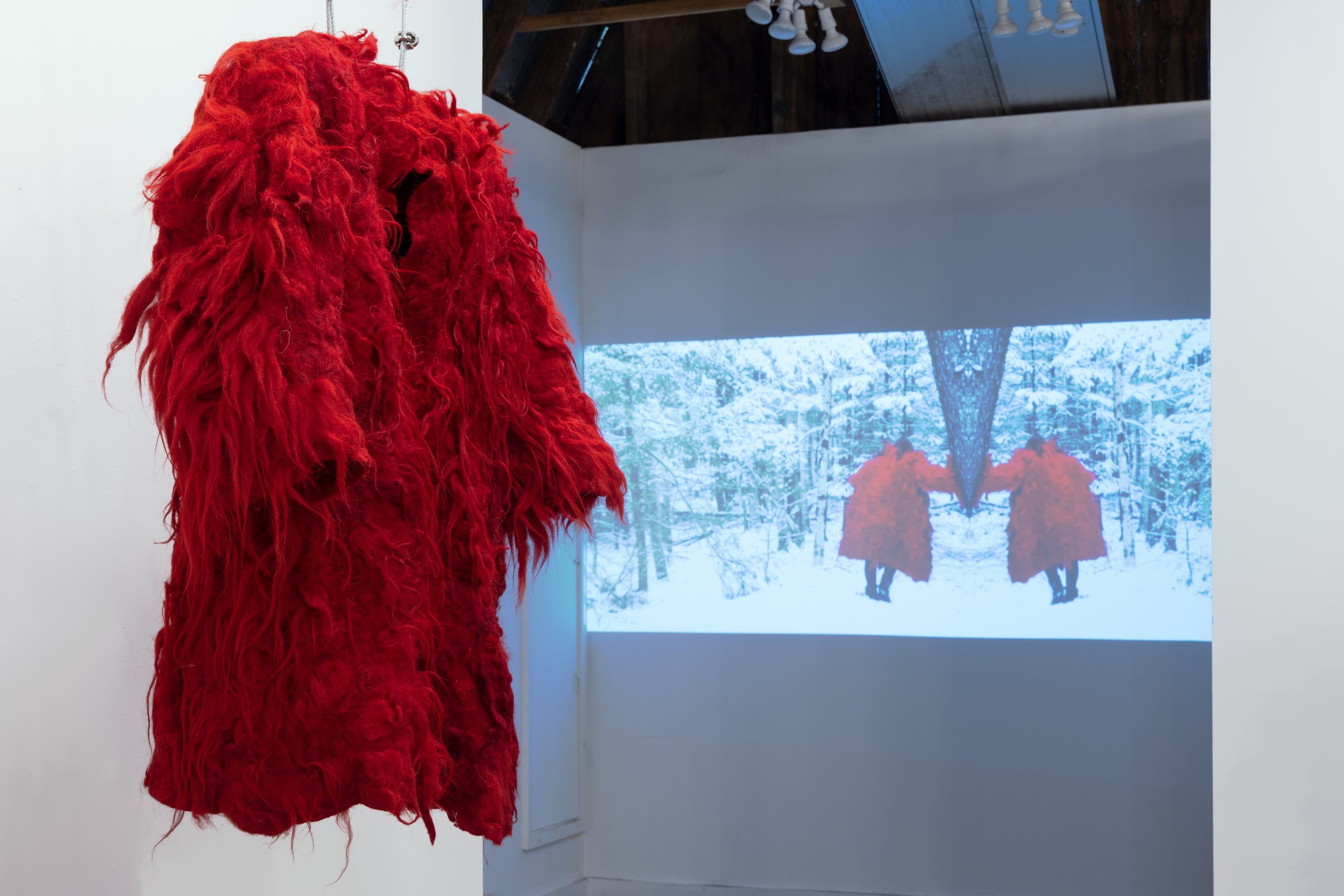
HUNIA is a video performance that explores the vanishing traditions of the Carpatho-Rusyn people through the symbolic presence of the traditional Rusyn wool garment. Worn historically for protection against the harsh Carpathian mountain climate and for ceremonial purposes, the HUNIA becomes more than clothing, it functions as a human symbol of identity, memory, resilience, and belonging. Rooted in personal memories of childhood summers in the mountain village of Tyushka, the work draws from family stories, shepherding traditions, and the rhythms of rural labor to reconnect with ancestral knowledge and endangered cultural practices. Through embodied gesture, movement, and material, the performance honors the subsistence lifestyle and spiritual connection to the Carpathian landscape that have persisted despite displacement, political instability, and cultural marginalization. The garment acts as a vessel of collective memory, carrying traces of past generations while preserving the living heritage of the Rusyn people through performance and ritual.
The Carpatho-Rusyns are a largely unknown, ethnically and linguistically distinct people living in remote villages scattered throughout the valleys of the Carpathian Mountains in eastern central Europe, indigenous to the Carpathian Mountains and surrounding areas. They have never had a state of their own, except declaring their independence from Czechoslovakia on March 15, 1939, and were formally annexed by Hungary one day later, existing for a mere 24 hours. Carpatho-Rusyns live as a national minority in Hungary, Slovakia, Poland, and Ukraine. Carpatho-Rusyns's shortest-lived state in history.
Of the estimated 1.2 to 1.6 million Carpatho-Rusyn, only about 75,000- 90,000 were officially recorded in recent censuses. This is largely because some census authorities don’t recognize them as a distinct ethnic group and because Carpatho-Rusyns intermingle with surrounding communities over time. Among the 250,000 Carpatho-Rusyns who immigrated to the United States, a total of 7583 have been identified. They immigrated between 1880 and 1920 and settled primarily in Pennsylvania and Pittsburgh, where they worked in the steel mills and coal mines.
Hunia- Permission To Be, Video Performance
Single-Chanel video work, 3 minute experts from 13.5 min
Hunia- Permission To Be, Video Performance
Single-Chanel video work, 3 minute experts from 13.5 mi